From Surveillance Boards to Sovereign Teams
Andy Carlberg
Strategic Technology Leader
Many teams implement Scrum as a rigid, prescribed process - a “by-the-book” checklist that rarely delivers the promised agility. When Scrum is treated this way, it’s a sign that why we do Scrum has not been understood. This type of implementation is based on a flawed assumption: that simply implementing the ceremonies of other teams will provide the same results.
The result is a common, growing frustration: developers feeling micromanaged as daily stand-ups devolve into rote, individual status updates. This breakdown isn’t just a process failure; it’s a symptom of a lack of team sovereignty. Scrum, at its core, is designed to give a team the agency to manage its own work, but that sovereignty is often undermined by the very tool meant to facilitate it: the Sprint Board. To fix the culture, we have to rethink how we map Story and Task ownership.
The Surveillance Board
The most common sprint board layout I see today is a series of columns representing a card’s journey to “Done,” but with one critical flaw: the horizontal swimlanes are categorized by developer names.
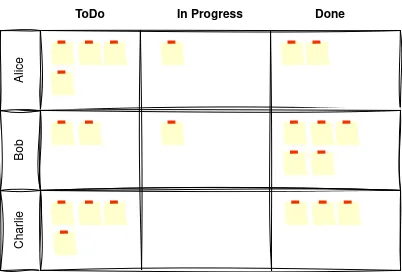
This layout betrays the board’s true purpose. Instead of a tool for delivery, it becomes a tool for tracking individual status. When the board is structured this way, individuals own the card, individuals move it across the board, and individuals are solely on the hook for its delivery. This is the antithesis of Scrum, where the team collectively commits to delivering value.
I suspect this stems from project-management-style leads who are more comfortable with traditional hierarchies than with agile self-organization. Tools like Jira don’t mandate this layout, but they easily support its implementation because it satisfies a management desire to see “who is doing what” at a glance. Unfortunately, that desire for individual visibility often overrides the collaborative, non-hierarchical structure a high-performing Scrum team needs to thrive.
Value vs. Labor
The surveillance board fails because it fails to distinguish between Value and Labor. By assigning stories to individuals and tracking their status as a row, we conflate the two. The labor —the specific actions required to build a feature—is mixed into the produced value of the story itself. A team truly gains sovereignty when they collectively own the Value and individually own the Labor.
In Scrum: The Art of Doing Twice the Work in Half the Time, Sutherland shares an anecdote from Eelco Rustenburg regarding a home renovation project. During the daily stand-up, Rustenburg gathered the specialists - carpenters, electricians, and plumbers - to facilitate a discussion focused on clearing blockers and making progress. This strategy kept a complex renovation on time, a notoriously difficult feat as any homeowner knows.
I like this story because it perfectly illustrates what happens when a Scrum team delivers value. Sutherland doesn’t detail the specific user stories, but we can assume most required multiple specialties. To install a kitchen sink, you need a carpenter to cut the counter and a plumber to run the lines - and perhaps an electrician if the sink has a disposal unit. None of the specialties delivers “Value” to the homeowner in isolation. The Value—a functional kitchen sink—was owned by the team, while the Labor—the wiring, the plumbing, the carpentry—was owned by the individuals.
The Story-Centric Board
Returning to the Sprint Board, we already have a layout that visually reinforces team ownership of Value. Sutherland published this format in Scrum: The Art of Doing Twice the Work in Half the Time, yet it is surprisingly rare to see it in the wild.
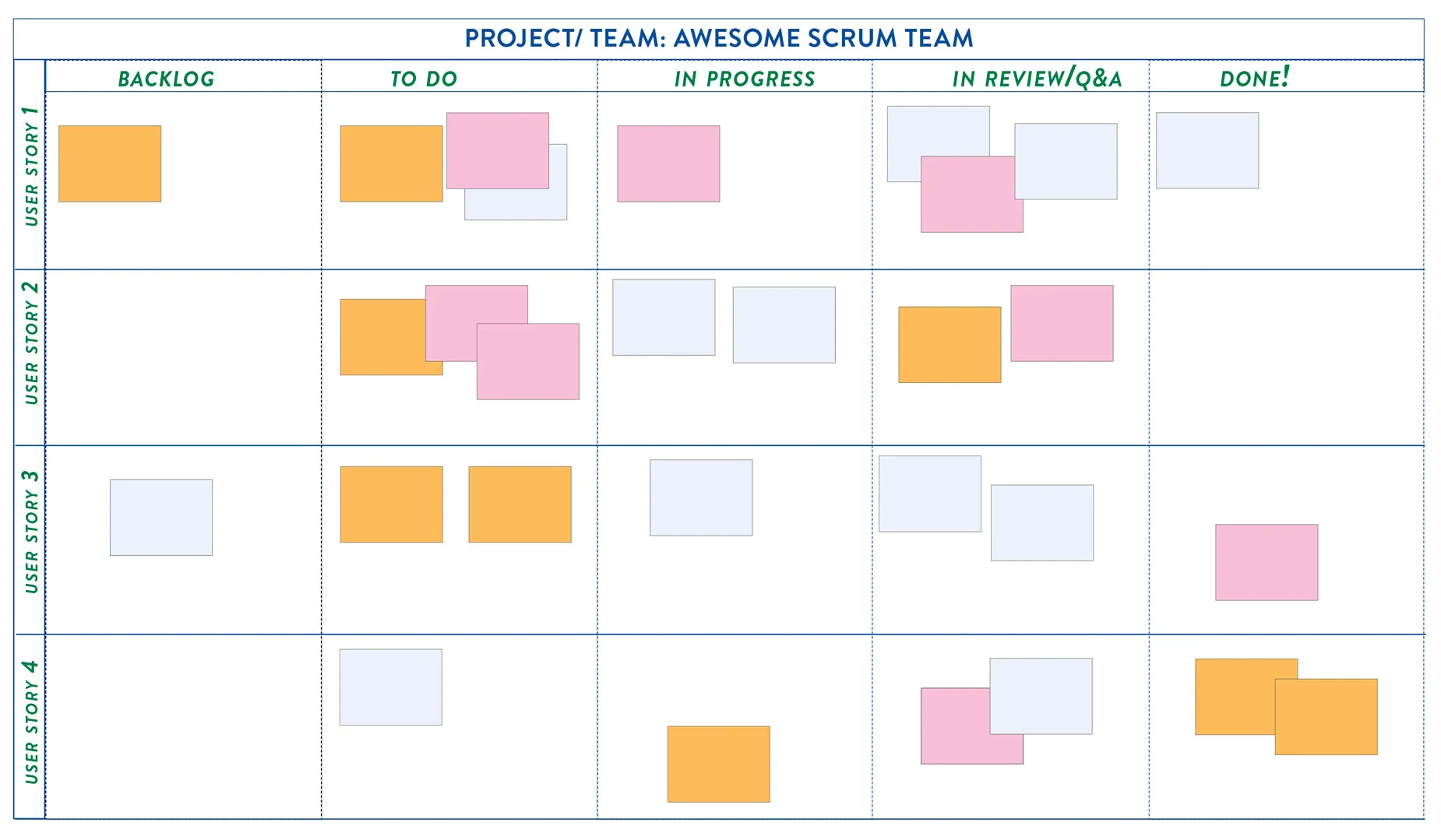 Image adapted from Jeff Sutherland, “Scrum: The Art of Doing Twice the Work in Half the
Time.”
Image adapted from Jeff Sutherland, “Scrum: The Art of Doing Twice the Work in Half the
Time.”
In this layout, the User Stories are the swimlanes. This simple shift ensures the board represents the team’s commitment to Value. Within each lane are the individual tasks—the Labor— which move through the process independently.
A story is binary: it is either “Done” or “Not Done.” You can judge its progress by looking at the remaining task notes in the lane. Tasks move through statuses and may be blocked, but the focus remains on delivering that vertical slice of value. In this format, the board ceases to be a surveillance tool and becomes a communication hub. It facilitates the critical conversations that actually drive a team forward, transforming the stand-up from a series of individual reports into a collective alignment session.
Passing the Baton
There is a subtle, key phrase Sutherland uses that reinforces this distinction:
(Sutherland, 2014, p. 155, emphasis added)When someone signs out a story, everyone knows who’s working on it.
While he doesn’t dwell on the mechanics of “signing out,” the phrasing is telling. It implies that while the Value belongs to the team, the responsibility for moving it forward is a baton passed between individuals.
This has been a core tenet of Scrum since its inception, yet so many teams have accidentally replaced the baton with a tether, tying stories to developers in a 1:1 relationship. By reclaiming the board, teams can reclaim their sovereignty—shifting the focus from “Who is busy?” to “How do we deliver this value together?”
The Goal is Sovereignty
The Sprint Board is a choice made by the self-organizing team. Its architecture influences how the team processes the information provided. If your board layout is designed for individual status check-ins, your developers will act accordingly - as individuals instead of a cohesive team.
By shifting the swimlanes from individuals to Stories, we change the orientation of the board. We stop asking “What did you do?” and start asking “What does the Story need?” That shift is a big step towards team sovereignty - turning a group of individuals into a team that owns their success.
Related Expertise